

Cold War Briefings: NATO Special Weapons Storage Sites in Germany
Briefing Issue 9- 7/13/26
NATO Special Weapons Storage Sites in Germany
During the Cold War (1947–1991), NATO's strategy heavily relied on nuclear deterrence to counter the perceived threat from the Soviet Union and the Warsaw Pact. "Special weapons" was a euphemism commonly used by the U.S. military to refer to nuclear weapons, which were deployed across Western Europe as part of NATO's nuclear sharing arrangements. West Germany, being on the front lines of the Iron Curtain, hosted a significant portion of these U.S.-controlled nuclear arsenals. These deployments began in the mid-1950s under agreements with the West German government and continued until the end of the Cold War, when most weapons were withdrawn or consolidated. At its peak in the late 1960s, the U.S. had around 8,000 nuclear weapons in Europe, with West Germany serving as a key hub due to its strategic location.
The purpose of these storage sites was to provide rapid access to tactical and theater-level nuclear weapons for use by U.S. and allied forces in the event of a Soviet invasion. Weapons remained under U.S. custody, with Permissive Action Links (PALs) ensuring American control over arming and detonation. East Germany, under Soviet influence, also hosted Soviet nuclear weapons from 1969 to 1991, but this report focuses on NATO (primarily U.S.) sites in West Germany.
Historical Background
The deployment of U.S. nuclear weapons to West Germany started in 1954, shortly after the country's integration into NATO. The U.S. approached Chancellor Konrad Adenauer to secure approval for introducing atomic weapons under occupation rights, transitioning to contractual agreements post-occupation. By 1955, initial stockpiles were established, and by the early 1960s, Supreme Headquarters Allied Powers Europe (SHAPE) planned for 13 stockpile sites in West Germany alone, accommodating five types of atomic weapons.
These sites were part of a NATO nuclear posture, which included nuclear sharing with allies like West Germany, where German pilots were trained to deliver U.S. bombs using dual-capable aircraft such as the F-104 Starfighter and later the Tornado. The deployments escalated during crises like the Berlin Crisis (1961) and the Cuban Missile Crisis (1962), reflecting heightened tensions.
Post-Cold War, under the 1990 Two Plus Four Treaty, nuclear weapons were prohibited in former East German territory and West Berlin. Most U.S. weapons were withdrawn from Germany in the 1990s, with only Büchel Air Base retaining a small number (estimated 10–15 B61 bombs as of 2025).

Types of Weapons Stored
U.S. nuclear weapons in West Germany included a variety of tactical and theater systems designed for battlefield use:
Gravity Bombs: Such as the B61, stored at air bases for delivery by fighter-bombers.
Ballistic Missiles: MGM-31 Pershing missiles (deployed from the 1960s to 1980s).
Cruise Missiles: Ground-launched variants like the BGM-109G Gryphon (1980s).
Nuclear Artillery: Shells for 155mm and 203mm howitzers, including the W48 and W79.
Surface-to-Air Missiles: Nike Hercules with nuclear warheads.
Short-Range Systems: Atomic Demolition Munitions (nuclear mines) and the MGR-1 Honest John rocket.
Man-Portable Devices: Davy Crockett recoilless gun system.
These were stored in reinforced bunkers or vaults, often under the Weapons Storage and Security System (WS3) for bombs at air bases. Warheads were maintained by U.S. units like the 59th Ordnance Brigade.
Known Storage Sites
Exact locations and numbers were classified during the Cold War, but declassified documents and historical accounts reveal several key sites. The following table summarizes major confirmed or reported U.S./NATO special weapons storage sites in West Germany:
Site Name | Location | Type/Description | Time Period | Associated Units/Weapons |
Büchel Air Base | Rhineland-Palatinate | Air base with underground WS3 vaults for gravity bombs. Still active post-Cold War. | 1950s–present | German Luftwaffe Tactical Air Force Wing 33; B61 bombs. Up to 20 warheads during peak. |
Ramstein Air Base | Rhineland-Palatinate | Major air base and storage hub with 44 vaults for gravity bombs. | 1950s–2007 | U.S. Air Force; stored bombs relocated from other bases like Nörvenich and Memmingen. |
Nörvenich Air Base | North Rhine-Westphalia | Air base for fighter-bombers; weapons moved to Ramstein in 1995. | 1950s–1995 | German Luftwaffe; dual-capable aircraft with U.S. bombs. |
Memmingen Air Base | Bavaria | Air base; closed in 2003 with weapons withdrawn earlier. | 1950s–2003 | German Luftwaffe; 20 bombs withdrawn in 2003. |
Waldstetten | Baden-Württemberg | Army bunker complex for Pershing missile warheads. | 1954–1980s | U.S. Army; array of 1950s-built storage bunkers. |
Münster Ammo Depot | Hesse | Ammunition depot for land-based systems. | 1960s–1980s | U.S. Army; nuclear artillery shells, mines, and Davy Crockett systems. |
Giessen Depot | Hesse | Storage facility for various nuclear weapons. | 1960s–1980s | U.S. Army; targeted in a 1977 mock terrorist exercise. |
Pirmasens (reported) | Rhineland-Palatinate | Ordnance depot associated with 59th Ordnance Brigade. | 1970s–1980s | U.S. Army; tactical nuclear warheads. |
Ahr Valley Bunker (Government Bunker) | Rhineland-Palatinate | Underground command center simulating nuclear scenarios. | 1960s–1980s | NATO exercises; not primary storage but related to nuclear planning. |
NATO Sites
These sites had a NATO numerical designation and where primary a storage site. List below area few known locations in West Germany.
NATO Site # | Location / Nearby Area | Type/Description |
NATO Site 23 | Feucht (near Feucht Army Airfield, Nürnberg area) | Special ammunition storage |
NATO Site 35 | Kitzingen / Kaltensondheim | Special Weapons Storage |
NATO Site 59 | Clausen / Münchweiler | Part of large ammo depot |
NATO Site 67 | Fischbach (Fischbach Kaserne) | One of the largest special ammunition depots. |
NATO Site 107 | Kriegsfeld (North Point) | Nuclear/special weapons depot. |
NATO Site 111 | Muenster-Dieburg (Muna Kaserne) | Major nuclear storage site. |
Sources for this list include declassified U.S and NATO. documents and historical analyses. Additional sites, such as Hahn, Bitburg, Spangdahlem, and Sembach Air Bases, were reported to have hosted nuclear-capable units, though specific storage details remain partially classified.
Security of Sites
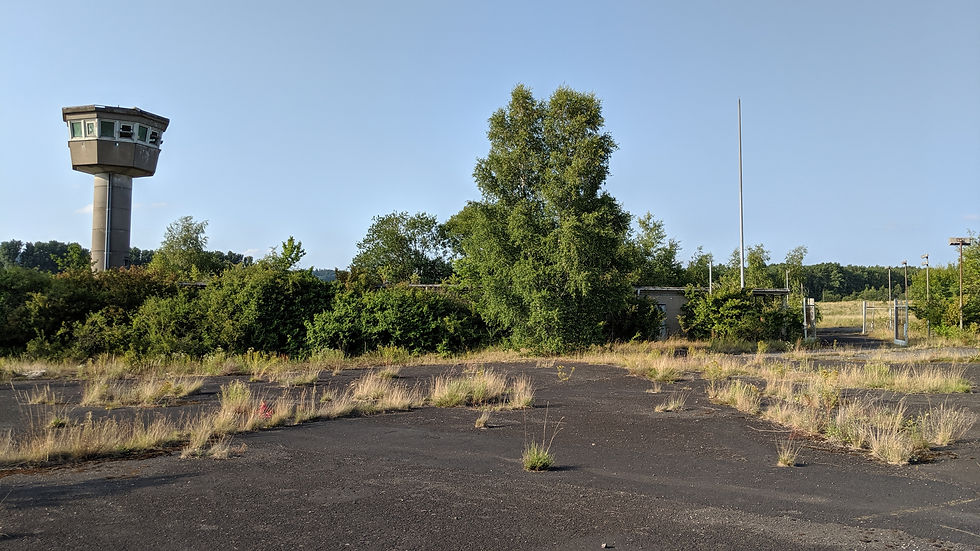
Storage sites were heavily secured with U.S. custodial agents, such as Military Police from units like the 507th U.S. Army Artillery Detachment (USAAD). Security included fenced perimeters, guards, and later electronic systems. NATO conducted exercises simulating nuclear war, including pre-emptive strikes, at facilities like the Ahr Valley Bunker. Incidents, such as a 1977 simulated terrorist attack on the Giessen site, highlighted vulnerabilities.

Key Security Features
Perimeter Security:
Multiple layers of fencing (often double or triple fences with razor wire).
Guard towers (typically 2–4 or more, some elevated with searchlights; veterans at Site 35 mentioned Towers 2 and 5, and up to four towers total).
Cleared areas around the perimeter for visibility and to prevent concealment.
Guard Force:
Military Police (MP) units (e.g., 981st MP Company at Site 35) provided 24/7 security.
Roles included: Gate guards, tower guards, roving patrols, fence patrols, and response teams.
Personnel Reliability Program (PRP): Only personnel with the highest security clearances and continuous evaluation could work at or guard the site.
Access Control:
Strict entry/exit procedures at the main gate (guard house / Site Security Control Center).
Badges, vehicle searches, and identification checks.
"Two-person rule" or multiple-person integrity for accessing sensitive areas.
Inner Security:
Bunkers/igloos for storing warheads had individual security (seals, alarms, locks).
Motion detectors, lighting, and intrusion detection systems.
Armed response forces on quick reaction.
Additional Measures:
Regular security checks and inventories.
Coordination with nearby units for backup.
High emphasis on preventing sabotage, theft, or unauthorized access (deadly force authorized in many cases).
These sites were designed to protect against both external threats (e.g., Soviet special forces) and internal risks. Veterans recall harsh conditions, especially in winter, with constant patrols and high alertness.
Security varied slightly by site but followed standard US Army / NATO protocols for nuclear weapons storage. Most measures were phased out or reduced after the sites closed in the 1990s.
End of the Cold War
With the Soviet Union's collapse in 1991, U.S. nuclear deployments in Europe were drastically reduced. Weapons from sites like Memmingen and Nörvenich were consolidated or removed. By 2007, Ramstein's arsenal was withdrawn, leaving Büchel as the sole remaining site in Germany. Many former sites have been repurposed or abandoned, with some, like Waldstetten, now historical landmarks.
Public protests, such as those at Büchel in the 1980s and 2010s, reflected ongoing debates over nuclear hosting. As of 2026, Germany's role in NATO nuclear sharing continues, though calls for full withdrawal persist. NATO's special weapons storage sites in West Germany were critical to Cold War deterrence, symbolizing the alliance's commitment to collective defense. While exact details remain sensitive, historical records reveal a network of air bases and depots that housed thousands of warheads. The legacy underscores the era's high-stakes nuclear brinkmanship and informs contemporary discussions on arms control.
References
Primary and Declassified Sources
1. National Security Archive** – "The U.S. Nuclear Presence in Western Europe, 1954-1962" (July 21, 2020). Details early deployments to West Germany, including initial stockpile sites and diplomatic arrangements with Chancellor Adenauer.
https://nsarchive.gwu.edu/briefing-book/nuclear-vault/2020-07-21/us-nuclear-presence-western-europe-1954-1962
2. National Security Archive** – SHAPE Histories and related declassifications (e.g., 1958 volume). Covers NATO planning for nuclear storage sites in West Germany and other allies.
https://unredacted.com/2013/06/28/nato-shape-histories-declassify-restricted-nuclear-data
3. Bulletin of the Atomic Scientists / Natural Resources Defense Council** – "Where They Were: The U.S. Nuclear Weapons Stockpile, 1951-1977" (1999). Provides chronology of deployments by country, including West Germany as the primary host with 21 weapon types from 1955 onward.
https://journals.sagepub.com/doi/10.2968/055006011 (or related Pentagon declassified history via NRDC)
4. Federation of American Scientists (FAS)** – Various reports, including "U.S. Nuclear Weapons in Europe" (2005) and updates by Hans M. Kristensen. Details WS3 vaults, base-specific storage (e.g., Ramstein, Büchel, Nörvenich), and historical numbers peaking at thousands in Germany.
https://www.nrdc.org/sites/default/files/euro.pdf (2005 NRDC/FAS collaboration)
https://fas.org/publication/united_states_removes_nuclear (2007 Ramstein withdrawal)
5. Nuclear Sharing Deployment History** – Overview of U.S. nuclear weapons in West Germany from the late 1950s, including sites like Ramstein, Büchel, Münster Ammo Depot, and others.
https://nuclearsharing.eu/en/nuclear-sharing/deployment-history
6. Arms Control Association / Center for Arms Control and Non-Proliferation** – "Fact Sheet: U.S. Nuclear Weapons in Europe" (updated post-Cold War context, referencing historical deployments).
https://armscontrolcenter.org/fact-sheet-u-s-nuclear-weapons-in-europe
7. Bulletin of the Atomic Scientists** – "United States nuclear weapons, 2025" (and prior Nuclear Notebooks). Historical estimates of stockpiles in Europe, with focus on Germany during the Cold War peak.
https://thebulletin.org/premium/2025-01/united-states-nuclear-weapons-2025
8. Sightraider / Urban Exploration Sources** – Documentation of former sites like Pershing warhead bunkers in Waldstetten and other southwest Germany locations.
https://www.sightraider.com/traces-of-the-cold-war-in-southwest-germany
9. Wikipedia and Aggregated Histories** (cross-referenced with primary sources) – Entries on Büchel Air Base, Ramstein Air Base, and Nörvenich Air Base, detailing WS3 vaults and transitions (e.g., weapons consolidated from Nörvenich/Memmingen to Ramstein in 1995, removed from Ramstein ~2007).
https://en.wikipedia.org/wiki/B%C3%BCchel_Air_Base
Written by Edward Kane
Copyright © 2026 Cold War Outpost History Group


Comments