

Cold War Briefings: US Army Daley Barracks
Briefing Issue 8- 5/4/26
Daley Barracks

Daley Barracks was a key U.S. Army installation in northern Bavaria, located on a hill at the edge of the spa town (Kurstadt) of Bad Kissingen. It served as home to thousands of American soldiers, their families, and support personnel for roughly forty years, from the early 1950s until the early 1990s. The barracks played a supporting role in NATO’s forward defense strategy in West Germany, primarily as a garrison for reconnaissance and cavalry units tasked with border surveillance and rapid response along the East German frontier. Its story mirrors the broader U.S. 7th Army experience in Europe: an uneasy transition from post-World War II occupation to Cold War readiness, followed by draw down after the Soviet collapse.
Pre-U.S. History and Early Post-WWII Use
The site originated as the Baron von Manteuffel Kaserne, constructed between August 1936 and May 1937 for the German Wehrmacht. During World War II, Bad Kissingen was declared an “open city” and largely escaped Allied bombing. Its many sanatoriums, hotels, and clinics turned it into a rest and convalescence center for wounded German soldiers.
On 7 April 1945, troops from the U.S. Third Army entered the city without resistance. The nearby airfield (Advanced Landing Ground R-98) was used by U.S. Army Air Forces for liaison duties. By late 1945, the XII Tactical Air Command operated from the area before departing in early 1948. From 1948 to 1950, the former kaserne housed the headquarters of the International Refugee Organization for Europe.
In 1951, the U.S. Army fully renovated Manteuffel Kaserne and reoccupied it. Additional land (30 acres in 1949 and another 23 acres in 1952) expanded the facility for a PX, commissary, enlisted men’s club, gym, bowling alley, ammunition storage, and dependent housing (later known as Daley Village). On 17 February 1953, General Order 1 from U.S. Army Europe Headquarters redesignated the installation Daley Barracks in honor of Technician Fifth Grade (Tech 5) William T. Daley. Daley, from Jamestown, New York, served as a truck driver and assistant section leader in the fuel and ammunition section of Headquarters and Service Troop, 94th Cavalry Reconnaissance Squadron (Mechanized), 14th Armored Division. On 15 April 1945, during the Battle of Creußen, Germany, his supply column was ambushed by German tanks and infantry. Daley dismounted under heavy fire, used his carbine to draw enemy attention away from his comrades, and continued fighting from a better position until all others reached cover. He was mortally wounded but enabled his unit’s survival. For this gallantry he received the Distinguished Service Cross (DSC) posthumously. His family only learned of the award in 1992.
Cold War Role and Units Stationed
Daley Barracks hosted a rotating mix of U.S. Army units, with cavalry and reconnaissance squadrons forming the backbone. Primary occupants included:
2nd Squadron, 14th Armored Cavalry Regiment (2/14 ACR) — Stationed there in the 1950s and 1960s; conducted border reconnaissance and surveillance.
2nd Squadron, 11th Armored Cavalry Regiment (2/11 ACR, “Eaglehorse” or Blackhorse - affiliated elements) — Took over border duties in later decades.
3rd Infantry Division Long Range Reconnaissance Patrol (LRRP) Detachment — Co-located in the early 1960s; shared barracks and mess facilities for deep reconnaissance missions.
Other elements: 2nd Battalion, 41st Field Artillery (2-41 FA), support units, and occasional VII Corps attachments.
The barracks’ strategic role centered on monitoring the inner-German border, particularly sectors near the Meiningen Gap and broader Fulda Gap approaches. Squadrons conducted mounted and dismounted patrols, border observation posts, and rapid-response drills as part of NATO’s forward defense. Equipment evolved from M1 rifles and scout jeeps in the early 1950s to M113 armored personnel carriers, M114 scout vehicles, M3 cavalry fighting vehicles, and M1 tanks by the 1980s–90s. Units trained regularly at Grafenwöhr and participated in REFORGER-style exercises.
The installation also supported VII Corps operations, including deployments that later extended to Operations Desert Shield/Storm (Kuwait, 1990–91). Three generations of soldiers passed through, from Constabulary-era troopers to those who saw the Cold War’s end.
Facilities, Daily Life, and Community
Daley Barracks featured standard kaserne amenities plus family housing in Daley Village (a satellite community under Schweinfurt Military Community administration). Soldiers lived in barracks buildings with motor pools, parade grounds, and a headquarters area. Families enjoyed American schools, a commissary, PX, clubs (NCO Club, EM Club, Officers’ Club), gym, bowling alley, and a movie theater. The spa town of Bad Kissingen offered a unique backdrop—soldiers and families mingled with German civilians in a resort setting, though tanks and military traffic occasionally strained local relations.
The post underwent three major renovations (1951 initial upgrade, 1973 major work, and a $4+ million community-wide modernization in 1984–86) to improve living conditions, heating, and infrastructure. Life combined long duty days (motor-pool maintenance, border rotations, training) with the comforts of small-town America abroad. Veterans recall it as one of the smaller U.S. installations in Germany, fostering tight-knit communities.
2/11 ACR (Eaglehorse Squadron) Border Missions During the Cold War
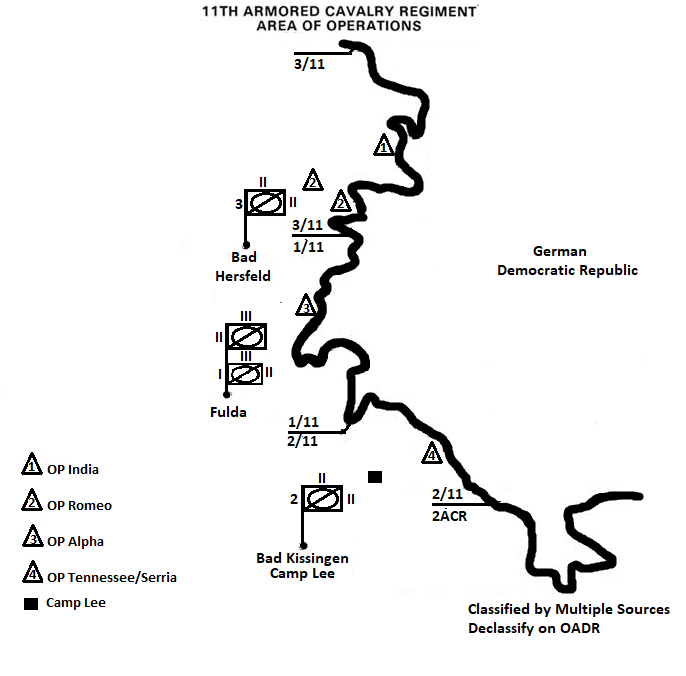
The 2nd Squadron, 11th Armored Cavalry Regiment ("Eaglehorse"), based at Daley Barracks in Bad Kissingen, Germany, conducted continuous border surveillance and reconnaissance along a sector of the East-West German border (Iron Curtain) from the early 1950s (initially as 2/14 ACR) through 1990. This mission was part of the broader 11th ACR responsibility for roughly 385 km of the border in the Fulda Gap/V Corps area, serving as the forward "eyes and ears" of NATO to deter and detect potential Warsaw Pact aggression.
Mission Overview and Sector
Primary Role: 24/7 surveillance, reconnaissance, and early warning along the border trace (the cleared strip, fences, and fortifications on the East German side). The squadron screened the flank of V Corps and provided intelligence on East German (Grenztruppen) and Soviet activities, troop movements, construction, and helicopter flights.
Key Area: Focused on the Meiningen Gap (a potential secondary armor corridor) near Bad Neustadt, running southeast along areas visible from Highway 19. The sector included terrain that could support armored thrusts toward Bad Kissingen, Schweinfurt, and beyond.
Transition: In May 1972, the 14th ACR was reflagged as the 11th ACR. 2/11 ACR assumed the mission at Daley Barracks, operating from Camp Lee (formerly Camp Wollbach, near Wollbach/Heustreu) as the forward border camp and Observation Post Tennessee (formerly OP Sierra) near Eußenhausen/Meiningen.
The border featured a sterile strip (plowed earth, fences, guard towers, and anti-vehicle obstacles) designed to prevent escapes from the East, not defend against Western attack. U.S. troopers faced East German guards, Soviet forces, and a tense atmosphere of constant observation.
Facilities
Camp Lee (Camp Wollbach/Phillip L. Lee): A "mini-kaserne" forward base for rotating troop-sized elements (about a month at a time). It included billets, motor pool, PX, dining facility, aid station, and operations center. It served as the hub for patrols and reaction forces.
Observation Posts (OPs): OP Tennessee/Sierra was the main permanent/manned vantage point overlooking the border crossing and East German facilities (e.g., near Henneberg). Teams rotated 24-hour shifts. Other temporary or in-depth listening/observation points existed along the trace and Highway 19.
Daley Barracks: Home station for training, maintenance, and reaction forces when not on border rotation.
Operations and Procedures
Patrols: Continuous mounted (jeeps, later M113s, M3 Bradleys, M1 Abrams in armored OPs), foot, and air (OH-58 Kiowa) patrols along the trace. Two-jeep patrols (scout jeep + machine gun jeep) were common—armed with M16s, night vision, cameras, flares, and radios. Patrols lasted 24–36 hours early on; later more structured. Combined U.S.-German (Bundesgrenzschutz) patrols occurred.
Manning: OPs and camps operated 24/7. Teams of ~8 (guards + observers) per shift at OPs. Reaction forces (armored) stood ready for incidents. Border Operations Center (at Camp Lee or squadron level) provided 24-hour oversight, spot reports, and quality control.
Surveillance Methods: Visual observation from towers/OPs, radar, listening posts, photography, debriefs, and coordination with German border police. Troopers were tested and certified on border rules of engagement, reporting, and procedures.
Reaction and Alerts: Quick-reaction teams extracted patrols if contact was lost or threats emerged. Frequent alerts (day/night) practiced rapid response. The squadron also served as a covering force for V Corps in case of invasion.
Equipment Evolution: Early 1950s — scout jeeps, machine-gun jeeps, half-tracks. Later — M113 APCs, Sheridan, Bradley's, M1 tanks for mobile OPs, night vision, and comms upgrades.
Rotation and Training: Troops rotated between home station (maintenance/training at Grafenwöhr, Hohenfels, Wildflecken) and border duty (often 90–120 days/year per soldier). REFORGER exercises tested full mobilization.
Daily Life and Challenges
Life was a mix of boredom, tension, and professionalism. Soldiers endured harsh weather (snow, cold—using "Mickey Mouse" boots and parkas), isolation, and the psychological weight of staring at armed Eastern forces. Incidents included shots fired (harassment or mistaken), accidental crossings (quickly resolved), sightings of Soviet helicopters/troops, and refugee pickups in earlier years.
Veterans recall jeep patrols with sandwiches/K-rations, radio relay points, static OPs, and occasional "unauthorized" stops at local spots on cold days. Intelligence work involved detailed debriefs and reporting "out of the ordinary" activity. Morale was bolstered by unit pride, German-American relations, and the clear sense of mission.
Post Cold War Closure of Daley Barracks end of the Border Mission
As the Cold War ended,The squadron ceased border operations on 1 March 1990 after the Berlin Wall fell (November 1989). The Iron Curtain vigil ended with the Soviet Union's dissolution. Units later moved (e.g., to Wildflecken) before inactivation.
The mission exemplified the Cold War "long watch"—no shots fired in anger by U.S. forces in this sector, but constant readiness that helped maintain the peace through deterrence. U.S. forces withdrew from Bad Kissingen around 1991–1993. VII Corps units, including the cavalry squadron, departed (many after returning from Kuwait), and the barracks were returned to German control. Most buildings were demolished in the years that followed; debris was used as landfill, and the site was redeveloped into commercial space (including a large retail complex). The housing area remained operational as a Schweinfurt satellite until mid-2005, when it was handed over to the German Government for conversion into mixed-income housing.

Today, little physical trace remains of the American presence, but the barracks’ history lives on through veteran associations, unit reunions, and local archives in Bad Kissingen that continue to collect stories from former residents. It stands as a tangible reminder of the U.S. commitment to NATO’s Central Front and the everyday lives of Cold War soldiers stationed far from home.
References
Eaglehorse.org (11th Armored Cavalry Regiment Association). “The History of Daley Barracks – Part 1.” http://www.eaglehorse.org/home_station/history/history_part_1/daley_barracks_history_1.htm
Eaglehorse.org. “Daley Barracks History – Part 3.” http://www.eaglehorse.org/home_station/history/history_part_3/daley_barracks_history_3.htm
Eaglehorse.org. “Home Station – Daley Barracks.” http://eaglehorse.org/home_station/home_station.htm
Eaglehorse.org. “Tech 5 William T. Daley.” http://www.eaglehorse.org/home_station/hidden_stories/50s/daley/daley.htm (biography and citation for the namesake of the barracks)
U.S. Army in Germany (usarmygermany.com). “Daley Barracks, Bad Kissingen.” https://www.usarmygermany.com/USAREUR_City_Schweinfurt.htm (includes construction timeline, WWII context, and facility details)
Wikipedia. “Bad Kissingen Airfield.” https://en.wikipedia.org/wiki/Bad_Kissingen_Airfield (covers pre-U.S. history of Manteuffel Kaserne and the 1953 renaming)
U.S. Army in Germany. “14th Armored Cavalry Regiment.” https://www.usarmygermany.com/units/ArmoredCav/USAREUR_14thACR.htm
Third Reich Ruins. “Cold War Sites” and “Wehrmacht Posts / Kaserne.” https://www.thirdreichruins.com/cold_war_sites.htm (photographic documentation of the site)
US Army Border Operations in Germany 1945-1983
written by William E. Stacy, fl. 1984 (District of Columbia: United States. Army. Center of Military History, 2002)
Written by Edward Kane
Copyright © 2026 Cold War Outpost History Group


I served in H troop, 2nd Squadron 14 ACR from April 1961 to October 1963.